
Russophobia versus Deception

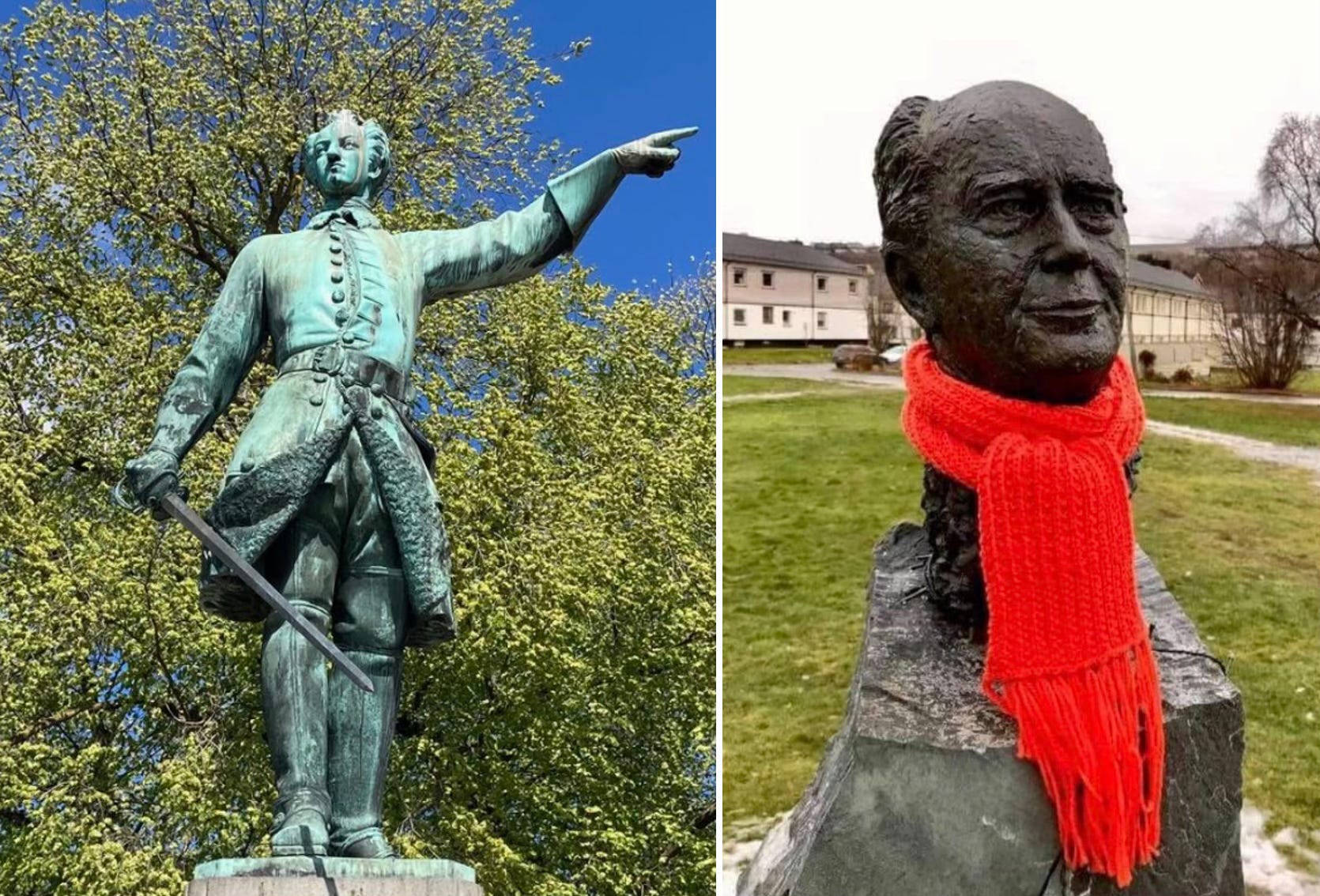
Left: Swedish King Charles XII (1682-1718) pointing with his hand eastwards, towards Russia that he tried to conquer in early 1700. The statue is from central Stockholm (My photo). Right: Statue of Norwegian Foreign Minister Thorvald Stoltenberg in Kirkenes on the border to Russia to honor him for initiating the Barents Region Cooperation between the Nordic countries and Russia in 1993 (The photo was given to his son, Jens Stoltenberg, by the Major of Kirkenes Rune Rafaelsen and published on Facebook). The father’s policy of developing trust and good relations between the Nordic countries and Russia, was different from his son’s policy as NATO General Secretary 30 years later, when he turned against Russia.
I have listened to some conversations about Russophobia with Prof. Richard Sakwa, Prof. Glenn Diesen, Prof. Pascal Lottaz and others, but I think that something is missing.
After 1700, Russia was always the main enemy of the Royal Sweden or “Military Sweden”. The Swedish King Charles XII tried to conquer Russia in the Great Northern War (1700-21) but lost in 1709 against Tsar Peter the Great in the Battle of Poltava in today’s Ukraine. Russia attacked the Swedish east coast in 1719. Sweden lost its Baltic Sea empire with Estonia, Latvia and the areas around St Petersburg. Sweden attacked Russia in 1788-90. In 1809, after the Swedish–Russian War, Sweden lost the whole Finland, one third of its territory. The many Swedish battles with the Russian great power were remembered by the Swedish military elite. Some people believed that the Ukrainian blue and yellow flag can be traced back to the Battle of Poltava, when Sweden was allied with some Ukrainian Cossacks.
During the Second World War, in 1939-40, Sweden’s Chief of Defense Staff, Major General Axel Rappe, wanted to move 2/3 of the Swedish Army to the Finnish front with the Soviet Union to once again fight the Russians. He did not believe in any threat from Nazi-Germany. The Social Democratic Prime Minister Per Albin Hansson turned him down, but according to the later Chief of Navy Admiral Stig H:son Erikson, Rappe tried to recruit him for a military coup to remove the democratically elected government to open up for a war against the Soviet Union. The coup-plotters hoped to ally with the more pro-German Swedish King Gustav V, but he refused. Lieutenant General Henry Kellgren had regular contacts with the German Defence Attaché, General von Uthmann, and in July 1942, Kellgren signed a Swedish military phrasebook at the Royal Palace prepared for a Swedish Army offensive into the Soviet Union. Later Chief of Army, Lieutenant General Archibald Douglas, was of the same view as Rappe and Kellgren. He believed Sweden would be able to conquer large parts of Soviet territory, territories that Sweden had lost in 18th and 19th century. He presented plans for the offensive, but the Government did not support him. In the 1980s, some Swedish officers prepared for a military coup against Swedish Prime Minister Olof Palme, who didn’t take the Russian threat “serious enough”. In 1985-86, the “Naval officer’s revolt” claimed that they did not have trust in Prime Minister Palme, because of his dialogue with Moscow and his weakness towards the Soviets. They even discussed the possibility of killing him. Olof Palme was shot in central Stockholm shortly afterwards. When I participated in an American military historians’ trip to Russia in Summer 1992 (primarily with US military intelligence officers), there were also a couple of Swedish officers: a general and a couple of junior officers. They were pre-occupied by the territories Sweden had lost to Russia in the 18th and 19th centuries. Sweden has traditionally had an important elite that was very Russo-phobic.
My mother, who had a background from a privileged part of Stockholm, could say about someone who was a bit crazy that “han är nästan rysk” [he is almost Russian], which didn’t mean that he was Russian, but just that he was unacceptable in one way or another. My stepfather, who had gone through the Swedish Naval Academy sang a drinking song that goes like this: ”And now we will follow a Russian to his grave; A Russian has been a crook in all his days; Go to hell; Go to hell; Now, a Russian is going to hell […] And the Russian is dead; And the coffin is red [and then you empty your glass of brandy and continue the song]; But hell knows if the Russian is really dead. […].
Later, my stepfather became more of a Social Democrat, but this song illustrates something of the Swedish Navy tradition, and these views inside the military and industrial elite of Sweden were suppressed during the many years of Social Democratic Government. After Prime Minister Olof Palme was shot in 1986, these people became increasingly visible.
A Norwegian admiral told me that he was shocked while visiting his opposite number in Sweden. The way the Swedish officers spoke about their Prime Minister had been impossible in Norway. Norway or the Kingdom of Denmark-Norway (1380-1814) had never been at war with Russia and nor had Norway under Swedish rule (1814-1905). Norwegian tension had been with Sweden. Denmark-Norway had, for a long-time, close ties to Russia, and the Norwegians had up to the Russian revolution 1917 had trade and close collaboration with Russians in the far North. Before the Second World War, many Norwegian officers were worried about the Soviet Union, and their views were colored by the British or the Germans, but this is nothing compared to the fanatic Russophobia that you would find among some Swedish officers.
After the Cold War, the close cooperation with Russia, the Barents Region initiative between the Nordic countries and North-western Russia, was a Norwegian initiative. It was initiated by Foreign Minister Thorvald Stoltenberg, who brought up the idea with Russian Foreign Minister Andrey Kozyrev at a breakfast meeting in Oslo in early 1992. I co-edited a book in 1993-94 about the Barents Region initiative, about its ambition to handle practicalities after the Cold War and to reduce the tension between two sides of the east-west divide (the book had a foreword by Thorvald Stoltenberg). Perhaps even more important for the understanding of the mindset in Norway, the Soviet Union liberated north Norway (East Finnmark) from Nazi Germany in October 1944 half a year before the rest of Norway was liberated, and this was very important for the Norwegian, and particularly for the north Norwegian feelings about Russians in general. At the 75-years anniversary for the liberation of Finnmark in October 2019, King Harald of Norway gave a speech in Kirkenes close to the Russian border:
“It was here, in Finnmark, that the liberation started. On 25 October 1944, the first Soviet forces advanced into Kirkenes and liberated the first parts of Norway. [The Soviet forces] came to villages and streets that were burnt to the ground. From the mine close to here, people came out [from their hiding] to greet their liberators. Norway has never forgotten and will never forget the great contribution our Russian neighbor made when our freedom mattered the most. In more than a thousand years, Norway and Russia have been living as good neighbors. Between our two countries, there has never been a war. Not many neighbors can refer to such a heritage. The only time when the war came to us, we were standing together.” And King Harald continues: “To our guests, I will remined you about what is written at the Western Graveyard in Oslo: ‘Norway, thanks you’. This is carved in stone. […].”
This is less than seven years ago. It is remarkable. The Norwegian TV aired a three hours’ program about the Russian liberation of northern Norway. They interviewed witnesses that told us about the Russian forces liberating Finnmark. 4000 locals had been hiding in the mine. Ten children were born in the dark tunnel. When the Russians came, there were joy and singing. The film shows how Norwegians are embracing their liberators. Of course, during the Cold War, many Norwegians, military officers, journalists and political leaders, who all were close to the Americans and the British, mistrusted the Soviets, but this mistrust was not against the Russians as people, and the Russian liberation was celebrated as late as 2019. Now a couple of years later, everything has changed. The British and American media have played a major role. For the political leadership, for Prime Minister Jonas Gahr Støre, a book by the anti-Russian Yale Professor, Timothy Snyder, has been most important, and Støre has given it to his friends. But Snyder’s presentation of a historical speech by Putin is directly false, and it has led to a biased interpretation of Russia. For Foreign Minister Eide, the UN Charter, the International Law, is most important, but he was not aware of what actually happened in Kiev in 2014. That is my understanding. He believed that Russia entered Ukraine to regain lost territories of the Soviet Union or Imperial Russia. The Russian war was interpreted as a war of aggression like Hitler’s war against Poland or against the Soviet Union.
I believe that Ivan Katchanovski’s analysis is most important. Probably all the shots or almost all the shots against the demonstration on 20 February 2014 came from buildings controlled by Svoboda and the Right Sector. The killings forced Yanukovich to flee, or rather Biden asked him to leave, because of all the killings. Biden told him that he “had lost the confidence of the Ukrainian people”. When we now know that the mass shooting was organized by people linked to the Americans, and when we also know about the telephone conversation of U.S. Assistant Secretary of State Victoria Nuland two weeks before this event, when she instructed her ambassador Geoffrey Pyatt to put together a new government, it became very clear that it was U.S. coup d’état. She instructed her ambassador about who should be the new Prime Minister, who the Prime Minister should talk to, and who he couldn’t bring into the Government. The new Kiev regime suppressed the majority’s revolt. The majority forces were attacked all over Eastern Ukraine. This was the minority’s coup against the majority that had elected Yanukovich in 2010. But it was also very much a U.S. coup. The U.S. military and the CIA arrived in Kiev almost immediately after the coup. It was an illegal takeover of Kiev and Western Ukraine using just a few hundred bullets, and then, in the coming months, the coup plotters took over most of Ukraine. A million Russian speakers fled to Russia, but still the resistance was strong in Yanukovich base area of Donbass. The new Kiev regime was not a legitimate regime, while the retreating East Ukrainian majority, what was left over from the democratically elected regime of Yanukovich, retreated to Donbass and its new regime should accordingly be understood as its legitimate “successor-regime”. It should be understood as the new legitimate regime of Ukraine. Russia’s military support for this regime was accordingly not be in breach of international law, while the support of the coup regime in Kiev certainly was. In praxis, the legitimacy of the Russian versus the Western intervention in Ukraine boils down to who was responsible for the mass shooting in Kiev on 20 February 2014. The following presidential election of Petro Poroshenko cannot be considered legitimate, because the voter turnout in the Yanukovich-dominated Eastern and Southern Ukraine was very low.
I think there are a couple of reasons why the Norwegian Foreign Ministry believes that the Russian invasion was in breach of International Law. Firstly, they believe that the Maidan demonstrations 2013-14 represented the Ukrainian majority and that these were more or less peaceful demonstrations. But the Ministry seems to have been unaware of the fact that these demonstrations became extremely violent and that they were organized by a fascist elite, celebrating the Second World War fascist leaders, Stepan Bandera and Roman Sjuchevitj, as their heroes. They mobilized the Western minority in violent clashes against the legitimate regime. Over the entrance to the Maidan headquarters, there was a huge portrait of Stepan Bandera, which disconfirms the Western narrative. Bandera had been fighting for a pure “Ukrainian” Ukraine, and “millions of victims have to be sacrificed in order to realize it”, he said. Sjuchevitj led an SS battalion and was responsible for the massacre of a hundred thousand Poles, Jews and Russians. Secondly, the Norwegian Foreign Ministry, like the Western media in general, believes that Yanokovich police forces were responsible for the massacre on 20 February 2014. This, they believe, discredited him as a President, and he had to leave. There had to be new elections and a new government, they argued. However, this argument has been totally disconfirmed by the study of Ivan Katchanovski and by a hundred of witnesses that has shown that the shots came from Hotel Ukraine and from a couple of other buildings, all controlled by the extreme rightwing parties Svoboda and Right Sector that had collaborated closely with the Americans. The legitimacy of the new leadership in Kiev was never questioned by the Ministry. Accordingly, the Republics of Donetsk and Lugansk in Donbass were perceived as illegitimate breakaway regions.
Of course, the understanding inside the Ministry was colored by the general Russophobia in the West, not least in Britain, and by the tragic experience of the Baltic peoples. The British initiated the Joint Expeditionary Force (JEF) in 2014 led by London with the Scandinavians and the Baltic states. This was very important, because it tied the traditionally détente-oriented Nordic countries to the Russo-phobic axis of Britain and the Baltic States. However, even more important: The Norwegian Foreign Ministry and the Norwegian media were fooled by a sophisticated deception run by primarily the Americans. The Minsk Agreement I and II from 2014 and 2015 was not just an instrument to postpone the war, to build-up the Ukrainian military forces, it was also an instrument to fool the Russians to accept the new government in Kiev, while also fooling the Europeans to look at this government as legitimate.
I think that Russophobia may explain much of Western behavior in recent years, but Russophobia has not been dominating in Norway. Different from Sweden, Norway has, historically speaking, not been Russo-phobic. In recent years, Russophobia has had a major role in Norwegian media, but it could have had this role because of a major deception orchestrated by the Americans and perhaps also by the British to present the coup in 2014 as legitimate and to present the invasion in 2022 as a “full-scale invasion” and an “unprovoked invasion”. This deception is a more important explanation. The history of Russophobia, as a form of propaganda, is, of course, significant. The histories of the British, Baltic, Polish, Swedish and French Russophobia have been important, but without a major deception, it wouldn’t have had that impact, particularly in Norway. What you could speak about just a few years ago, you cannot speak about any longer.
Firstly: the enlargement of NATO and the transfer of U.S. forces eastwards towards the Russian border were clearly in breach of International Law, with the Western agreement with President Gorbachev in 1990-91 (and oral agreements are no less binding than a formal treaty). That this enlargement would lead to a catastrophe was obvious for the founder of the NATO Containment strategy, George Kennan, and the American elite were well aware of the fact that the inclusion of Ukraine in NATO would provoke a major war.
Secondly, the U.S. and Western Ukrainian killing of many of their own people in 2014, which was used to justify a coup against President Yanukovich and a violent takeover of most of Ukraine, was a blatant breach of International Law. It was the minority’s coup against the majority. It was a Western military takeover of large parts of Ukraine that equals any invasion.
Thirdly, in 2014, the Western supported Kiev forces started a war against what was leftover of the Yanukovich regime in Donbass. This war led to 14,000 dead in Donbass, according to UN figures. One million Russian-speakers fled to Russia. It was an ethnic cleansing in breach of International Law. The killings of civilians in Donbass had the same role as the Israeli killing of civilian Palestinians in Palestine in 1948. It led to a major ethnic cleansing.
Fourthly, in 2019 the Ukraine parliament took a decision to change the constitution to be able to join NATO. In 2021, Ukraine signed an agreement with the U.S. to open for joining NATO. This was definitely in breach of the 2015 Minsk II Agreement signed at the UN Security Council. It was in breach of International Law. The extreme rightwing Security Chief in Ukraine, Oleksij Danilov, said that the Minsk Agreement “means the country’s destruction”.
Fifthly, two RAND reports in 2019 later became U.S. policy using a war in Ukraine to “destabilize” Russia. The argument for the US war in Ukraine was “to weaken Russia”, to quote US Secretary of Defense Lloyd Austin. One wanted to destabilize Russia, but the UN Charter does not only forbid an invasion into another country, but also the threat to peace in the region. The US policy was definitely in breach of International Law.
Sixthly, the Russian invasion in 2022 was described as in breach of International Law, but if Donbass was a legitimate “successor state” to Yanokovich democratic state (as stated above), the Russian intervention would be in accordance with International Law, while the Western support of the illegal Kiev regime would be in breach of International Law. The responsibility for the war would be turned upside-down. Who is in breach of International Law or not boils down to who was responsible for the mass shooting on 20 February 2014.
For the Norwegian Foreign Ministry as well as for many in the Western community, their support for Ukraine is not primarily about Russophobia but about deception. One has been fooled to believe that Russia, not the West, has been in breach of International Law. British and others’ Russophobia has a role, but most important has been a very deliberate deception operation that has fooled not just large parts of the population but also Western ministries.
Important points here. Nobody knows most of this older history or the sad recent history of the USA intervention in the Ukrainian situation over the last decade plus. The tactical tide (regardless of western invention in this proxy war) is fully turning against the Ukrainian forces in the eastern Donbas battle space. There are least five (5) separate cauldrons slowing closing around the Ukraine forces, they will be trapped. They will either have to surrender or as Kiev as instructed “die in place” or words to that effect. The humiliation of the Russian Federation sought by the west is not likely to happen in Ukraine and for that matter any time soon. Finland which had wisely remained neutral for decades, (don’t poke the Bear) may not have liked their great neighbors but they knew enough not to pick a fight. Now, with the cardboard cut out of a president Alex Stubb (well he looks the part) Finland has joined NATO, just in time to receive no benefit and be part of then unwinding. It is going to all reveal itself as the war in Ukraine ends, not with a bang but a whimper.
Excellent. Thank you for the succinct summary of the Maidan and its course. It is already becoming clear that the US strategy to weaken Russia and by doing so strengthen US hegemony has backfired. Together with the Iran war and the 'wager' on the Gulf tyrants against their Arab people, the war on Ukraine will be remembered as a milestone in the descent of the anglo empire to impotence and irrelevance.