
The U.S. nuclear umbrella – Does it exist?


From 1977 to 1989, Rainer Rupp was a West German civilian representative at the NATO Headquarters. As Chair of NATO Current Intelligence Group in the 1980s, he had access to Cosmic Top-Secret documents, while he was working as a spy for East German intelligence. His code name was “Topaz”. In 1993, Rupp was caught by German authorities, and he risked a lifetime sentence in prison, but in 1994 he was give 12 years in prison, because he had tried to avoid a war. He was released after six years. He was, in 1983, most likely the single most important individual making Europe able to avoid a nuclear war and World War III (Photo: the website of Rainer Rupp).
According to a popular view, states covered by the U.S. “nuclear umbrella” was protected by U.S. nuclear weapons, but against whom was the U.S. to launch these weapons? The U.S. could not launch them against the Soviet Union and later Russia without risking a Russian nuclear counterattack on the United States. During the Cold War, the U.S. “nuclear umbrella” presupposed the existence of the Warsaw Pact states that could be targeted by U.S. nuclear weapons. The “nuclear umbrella” also presupposed a general perception of a U.S. escalation dominance that would allow the United States to escalate and deter a Soviet attack, also at the higher levels of escalation. Neither of these preconditions exist today. There is, accordingly, no longer a U.S. “nuclear umbrella”. But let us start by looking at the 1980s to understand the logic of this very strange “umbrella”.
At the NATO Headquarters in the early 1980s, U.S. neoconservatives had pushed for a nuclear “decapitation strike”. They wanted to use the very precise Pershing II missiles that would reach Moscow in ten minutes to take out the whole Soviet civilian and military leadership, to make “the mighty Red Army run” around “like decapitated chickens”. The neoconservatives tried to implement these ideas as part of NATO’s plans, and the Soviets would certainly have been aware of this ambition. In November 1983, Soviet intelligence picked up the orders from the NATO command centers during a very realistic NATO nuclear exercise, Able Archer. The Pershing missiles were moved into place. The codes were changed and everything was very real, which made the Soviets believe that the NATO exercise was a cover for a real nuclear strike. The Soviets were convinced that the West prepared for “a decapitation strike” with an imminent nuclear attack. The Soviets responded by ordering their nuclear bomber forces in East Germany out on the runways. All these aircraft were just waiting for a signal to go, with their engines running. A U.S. or NATO nuclear attack on the Soviet Union would imply an enormous destruction. To the Russians, it was necessary to strike first, to destroy the Pershing missiles and other U.S. or NATO nuclear forces, before these forces were able to hit the Soviet Union. The Soviets were convinced that they had to strike pre-emptively to survive. However, an East German spy at the NATO Headquarters, Rainer Rupp, reported to the East Germans and the Russians that Able Archer was just an exercise. He was able to convince them that it was not a real nuclear attack, and the Soviet nuclear “counterattack” was stopped, which we are now all very happy about. The CIA report about Able Archer and about the Soviet war scare had supposedly shocked President Reagan to a degree that it totally changed his policy. He started his talks with the Soviet leader Mikhail Gorbachev in 1985.
In an interview with Pascal Lottaz, Rainer Rupp said that a top-secret document, “one of the most secret documents of NATO of the Military Committee […] said quite clearly: the Soviet Union doesn’t want a war with NATO. Their strategy is, if a war breaks out, that they [will] do everything [to ensure] that the war will not be fought on socialist territory, but to carry it across into the territory of the aggressor.” The Soviets did not think in terms of an attack on the West, but they would strike back, possibly preemptively in case of a Western attack.
In another of Pascal Lottaz’ interviews with Rainer Rupp, he says: “In the [upcoming] weeks, I had to chair the Current Intelligence Group in the Situation Center of NATO, that is the innermost sanctum, where all the intelligence information from member countries come in. The CIA and the DIA send their assessments of new developments etc., and I could see the intelligence memorandum of the DIA, how they discovered communication nodes of air defence systems in the north of Russia […] and you can read it nowadays in [the later official CIA Historian] Ben Fischer’s [now declassified paper on the Able Archer nuclear exercise …]. In the course of the [biannual WINTEX] exercises, the use of these tactical nuclear weapons became bigger and bigger [and in] the last exercise, already after the meeting of Gorbachev and Reagan, we actually used, I think, 153 tactical nuclear weapons in two waves: First over a hundred on Eastern European industrial but also mainly on military targets. Then, [after three days], the rest. So, all in all, I remember 153, and that was for the first time also nuclear weapons on East Germany, because up to then the Germans had always insisted that there would not be a nuclear weapon on East Germany. But interestingly enough, there […] was on Dresden. I remember well, because of the historic parallel of the firebombing of Dresden […]. An important point [was] that the target selection during WINTEX – for the use of nuclear weapons in the East – was always done [by the Americans]. That was an American prerogative. So, the target selection never touched Russian territory. Never. Why? Implicitly, it is very clear because the Americans knew that from the moment, they hit Russian territory, it is going to come back against American territory, in the United States. And that is the old question of the reliability of the nuclear umbrella, of the U.S. nuclear umbrella for Germany. I mean, [the Americans] were quite happy to fight to the last German in a war against Russia or to even destroy most of Europe. […] I remember in that context a presentation at the Nuclear Planning meeting in Oberammergau, where I participated, and an American general presented the problem of the Fulda Gap [… where the massive Soviet forces were supposed to roll into West Germany]. In the Fulda Gap we got a real problem [, he said]: ‘the German villages were only half a kiloton away from each other’.”
The idea of a U.S. “nuclear umbrella” for Europe presupposed the existence of the Warsaw Pact states that the U.S. could target. The Germans participants did not like that the U.S. would use nuclear weapons to bomb East Germany. The Germans wanted the U.S. to use the “bombs” further east (in Poland, Czechoslovakia and Hungary), but not in Germany. The short-range nuclear missiles presupposed, however, that a large proportion of them would be used in East Germany and against the Soviet forces entering West Germany. A former Commander-in-Chief of BALTAP (the NATO Command Baltic Approaches in Karup for Denmark and Northen Germany) told me that Special Forces were prepared for carrying backpacks with nuclear weapons, and they would not reach very far. In a European war, much of the U.S. tactical nuclear weapons would almost certainly be used in Germany.
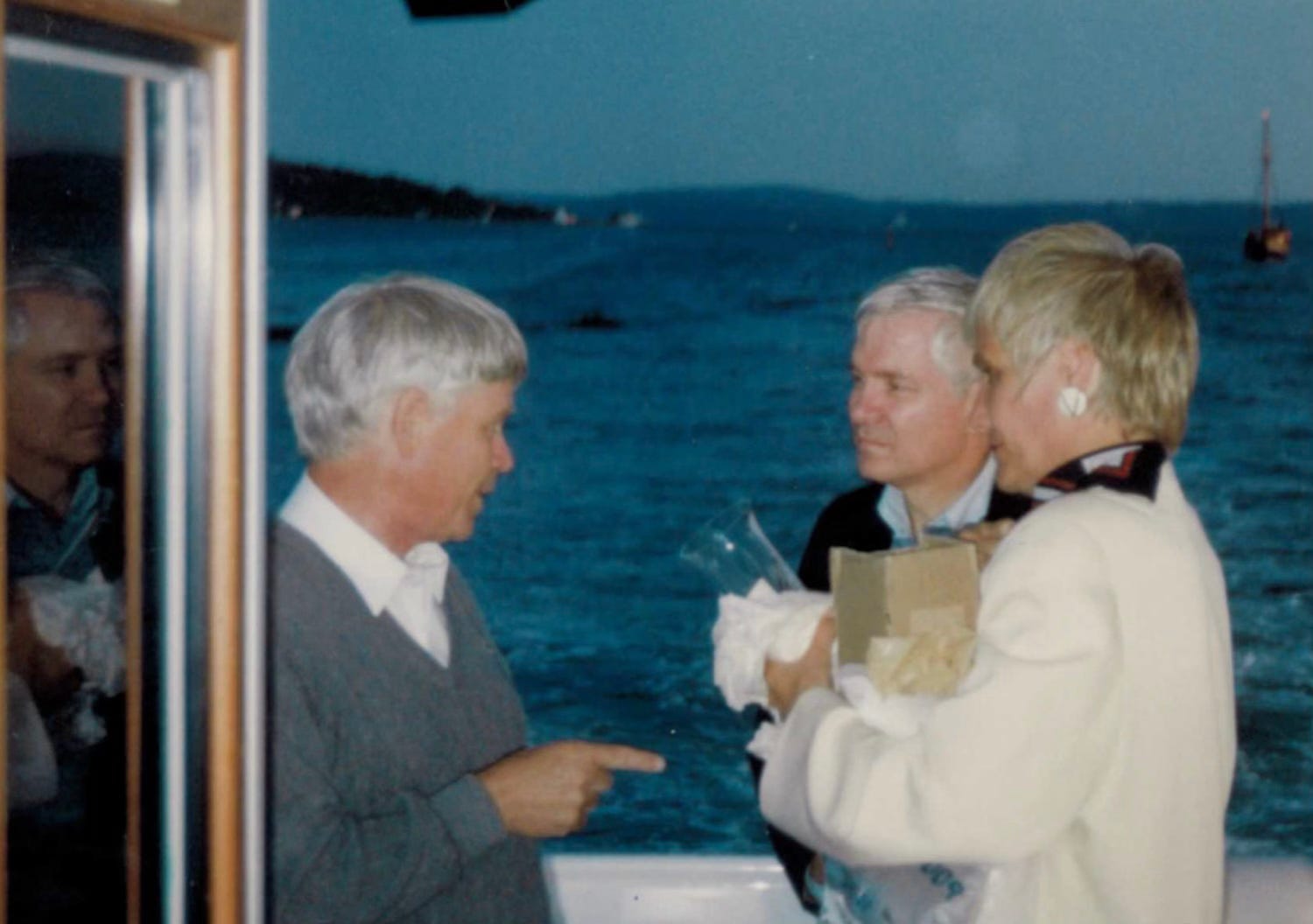
Norwegian Chief of Military Intelligence Alf Roar Berg (a former Chief of the Nike air defence systems) on the Oslo Fjord in June 1992 together with CIA Director Robert Gates and the U.S. Ambassador to Norway Loret Miller Ruppe (Photo: private archive).
The Norwegians were also unhappy about the fact that the nuclear weapons in the North were going to be used in Finnmark in Northern Norway, because they could not be used against the Soviet Union. Furthermore, in Norway, the Nike missile air defence systems had conventional warheads and were officially deployed to protect the capital of Oslo, but in wartime these missiles would be deployed with nuclear warheads, and these Norwegian Nike batteries had already storages prepared for their nuclear warheads, I was told by a former chief of these missile systems, the later Chief of Military Intelligence Major General Alf Roar Berg. The idea was that these nuclear surface-to-air missiles were going to be used against the swarms of Soviet nuclear bombers forces heading for the U.S. nuclear bomber forces in the UK and perhaps for the U.S., General Berg told me. The same was the case in Denmark, West Germany, the Netherlands and Belgium. The Nike batteries made up a wall of nuclear missile forces through Europe from north to south, a nuclear shield that would block the Soviet bomber forces’ access to the UK. The radioactive fallout from the many nuclear explosions would rain down over Scandinavia and Germany from inside the nuclear umbrella.
Most Europeans probably believed that the U.S. nuclear umbrella was going to be used, in one way or the other, to protect the Europeans against the Soviet Union and now Russia. One believed that the umbrella was going to protect us from Soviet nuclear weapons by using a U.S. nuclear deterrent directed against the Soviet Union, and the U.S. escalation dominance (see former article on my Substack) would deter the Soviets from any “adventure”. However, if the “deterrence fail”, these U.S. weapons were going to be used in Europe. The U.S. nuclear weapons were always going rain down from inside the umbrella. During the NATO exercises, the U.S. did never target the Soviet Union or Russia.
Today, there is no Warsaw Pact. We have an extended Western Europe, and the U.S. tactical nuclear weapons would, if used, be used in Europe, not against Russia, because a U.S. nuclear strike against Russia would immediately be followed by a Russian nuclear strike on the United States. In a U.S.-Russian war, Russia might for example create a buffer zone in Norwegian Finnmark to protect the Kola bases (close to Norway), to make it possible to defend them against a Western attack. This would be a scenario when the U.S. might use nuclear weapons, but the U.S. would use these weapons against Russian forces in Norway, in Finnmark, and against Norwegian infrastructure, not against Russia. Some people argue that the U.S. strategic nuclear forces (forces that would be used against Russia in case of a final escalation) would be enough of a deterrent to make the Russians back down, but that would presuppose a U.S. escalation dominance, and this escalation dominance does no longer exist (see my former Substack article). There is no longer a U.S. “nuclear umbrella”. Many people in Europe have misunderstood what a U.S. “nuclear umbrella” would mean to Europe.
Today, one is also talking about a possible “French nuclear umbrella” as a replacement of the U.S. “nuclear umbrella”, but also France would for obvious reasons try to avoid using nuclear weapons against Russia. In case of a massive Western (including French) conventional missile attack against Russia, Russia would (according to the new nuclear doctrine from September 2024) possibly use nuclear weapons, which could provoke France to retaliate with the use of nuclear weapons, but also that would be very risky, because the destruction in France would be totally unacceptable compared to the destruction in Russia. There does not seem to be any credible option for Western powers to use nuclear weapons in a war with Russia.
Hypothetically speaking, one can imagine that president Trump would take a decision to launch a nuclear missile strike against Russia and that Russia would respond by a nuclear strike on the United States, but, as I wrote in my article on “Escalation Dominance”, the responsible people in Pentagon would then be worried that the U.S. missiles might be taken down by Russian air defence, while the U.S. would definitely not be able to intercept the new Russian hypersonic missiles. It is accordingly almost impossible to imagine that the U.S. would enter a conflict in Europe that might escalate to a strategic nuclear level. One would almost certainly back down and “delegate” the war to the Europeans. The Europeans are now on their own, but they don’t have to worry. The Russians are not interested in Europe or in conquering European territory. The Russians still don’t think in terms of an attack, on invading Europe. The Europeans can actually calm down.
A fictional version of Rainer Rupp and Able Archer can be seen in the climax of the TV series Deutschland 83.
Extremely valuable. And a timely reminder of how much we all owe to Rainer Rupp. (And also to Reagan and Gorbachev).