
From U.S. Horizontal Escalation to Russian Escalation Dominance
Strategic Naval Thinking and Capabilities in the 1980s and Today

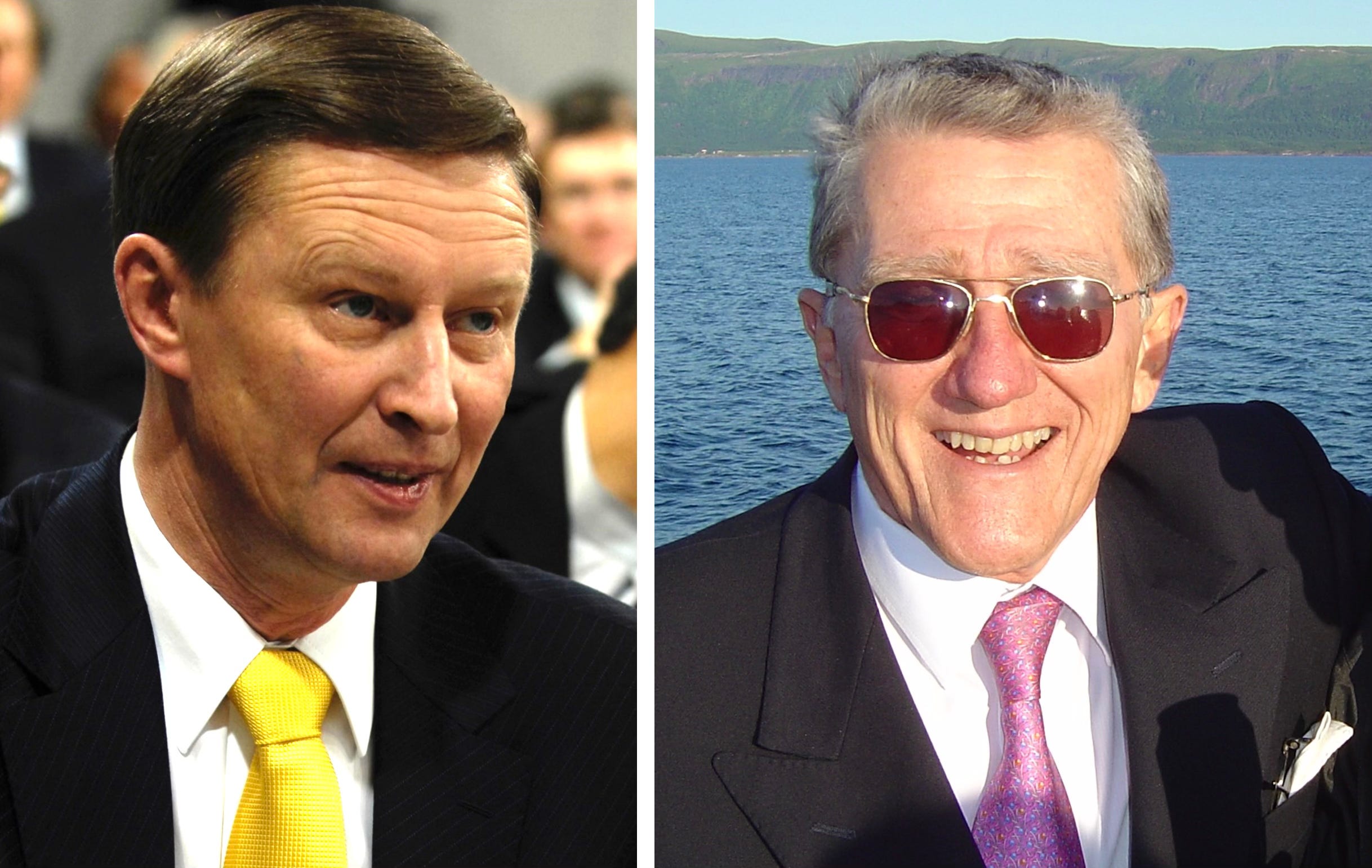
Left: Defence Minister Sergei Ivanov in 2007, later First Deputy Prime Minister (for military industry) and Chief of Staff of President Vladimir Putin (Photo: Wikipedia). Right: Former U.S. Secretary of the Navy John Lehman in 2007, in Vestfjord (Norway), where his aircraft carriers should seek radar shadow (Photo: Private archive, The Maritime Strategy Conference, Norwegian Institute for Defence Studies, Bodø). The paper below was presented at the International Sea Power Conference “The World Ocean - a Space for Cooperation and Competition» - ‘Old Theatres – New Challenges’. In memory of Fleet Admiral S.G. Gorshkov.” It was held at The Primakov National Research Institute of World Economy and International Relations, Russian Academy of Science (IMEMO), 20-21 November 2025. My paper brings up the U.S. advantage in the 1980s in the Maritime Theatre in the North, which would have forced Russia to back down in case of a confrontation and which later forced Russia to develop its capabilities at the upper end of the escalation ladder. The technological changes and Russian strategic investments have forced the U.S. to accept a more cautious attitude. Perceptions about an escalation dominance have been turned upside-down.
The conference brought together scholars and admirals from many countries, from Russia, from Asian and African countries, and from Greece and Turkey. There were also a U.S. member of the Arctic Council and two scholars from Western Europe: Alexandre Sheldon-Duplaix and me. Sheldon-Duplaix was a researcher at the French Ministry of Defence and teacher at the Defence Staff. He has written several volumes on submarine history. I was a research professor at the Peace Research Institute Oslo (PRIO) and have written books on geopolitics, submarine operations and deception. Both of us brought up U.S. Cold War deception with the use of Western submarines in Swedish waters. But now, I will first give a few words of background to the topic.
From late 1980s, PRIO and the Defence Research Institute in Oslo organized conferences and seminars on naval strategy and confidence-building in the high north, one with President Reagan’s Assistant Secretary of Defense, Francis ‘Bing’ West, from Naval War College, who headed “Sea Plan 2000”. This plan became the foundation for President Reagan’s and Navy Secretary John Lehman’s Maritime Strategy. We had a seminar with former President of the Naval War College and Director of the CIA, Admiral Stansfield Turner, with the Dean of Naval War College, Robert Wood, and with European and Russian contributors, which resulted in a book, Naval Arms Control (edited by Sverre Lodgaard). I wrote a chapter on “Regional restraint at sea”. My doctoral thesis about the U.S. Maritime Strategy was used as a textbook at the U.S. Naval War College. John Lehman said later some nice words about it to the British Sunday Times, to the journalist Pelle Neroth.
After my doctoral thesis and after an Oslo conference in 1989, I recruited Professor Robert Bathurst from the U.S. Naval Postgraduate School (Monterey) to PRIO. We participated in conferences with U.S. Navy and Russian Navy officers. Robert Bathurst had been heading the U.S.-Soviet hotline, been U.S. assistant attaché to Moscow and been head of Attaché Affairs Eastern Europe. He was Chief U.S. Naval Intelligence Europe and held the Admiral Layton Chair of Intelligence at the Naval War College, while Stansfield Turner was president at the college. In early 1990s, we had several conferences together with U.S., European and Russian participants. PRIO had a couple of seminars with the Russian Navy’s “Peace to the Ocean Committee”. In 1993, I headed a Norwegian “delegation” on a Russian naval ship with Bathurst, myself, and individuals from the Norwegian Navy, the Defence Ministry and Defence Research Institute. My and Bathurst’s opposite numbers were Major General Pyotr Barabolja and Admiral Nikolai Amelko. The latter gave me lecture on Soviet submarines in the Baltic. I was skeptical, but the same summer I had talks with former CIA Director James Schlesinger, who confirmed a U.S. role in Swedish waters. Admiral Amelko and Admiral Sergey Gorshkov had been the most high-ranking naval officer in the Soviet Union. In the 1980s, Amelko was the deputy to the chiefs of the General Staff, Marshal Ogarkov and Marshal Akhromeyev. Two of the new Russian frigates are now named after Admiral Gorshkov and Admiral Amelko. The former was the Soviet Chief of Navy for 30 years, from 1956 to 1986.
This frigate program was initiated in 2005 under Defence Minister Sergei Ivanov. He later became Deputy Prime Minister (responsible for military industry) and Chief of Staff to President Vladimir Putin. Ivanov put priority on the strategic submarines, the new quiet Borei class to operate in Arctic waters. But also, on the very quiet Yasen class. Sergei Ivanov said: “that about 40 percent of the military budget would be spent on the Navy in 2009, mainly on building Project 955 [the Borei class submarine]” (Andrei Frolov 2009). One had to secure the “second strike capability” and have a real capability at the upper end of the escalation ladder. The first tests of hypersonic missiles were also under Defence Minister Ivanov. These missiles would supposedly make “U.S. proposed missile-defense system useless”.
When I saw Sergei Ivanov as a minister of defense after 2001, I recognized him from the 1980s. At a conference about Arctic Security at the International Affairs Institute in Helsinki in 1987, I gave a talk about the U.S. Forward Maritime Strategy and “four scenarios for the Norwegian Sea”. I was just moving from Sweden to my job as researcher at PRIO in Norway, and I was finishing my doctoral thesis on U.S. Maritime Strategy. Sergei Ivanov was a young Third Secretary at the Soviet Embassy in Helsinki, and he was very interested in the Maritime Strategy and the U.S. scenarios that would follow from it. He spoke fluent Swedish without an accent. He had never been to Sweden, he said. Not many universities had that good language skills. My first reaction was that he must be from the KGB, which turned out to be correct.
His problem was that the U.S. Forward Maritime Strategy had made Admiral Gorshkov’s global presence almost irrelevant. The U.S. forward deployments had made Moscow forced to retreat and put priority on defending the noisy strategic submarines. One had to focus on a “bastion defence” in the Arctic. When the U.S. Navy stated that one would take out the Russian strategic submarines, it was impossible for Moscow to know whether any Russian ballistic missile submarines would survive a confrontation. The submarines could not contact the base, because they would then reveal their position. Moscow would have to worry about its “second-strike capability”. One would have to retreat and adapt to U.S. demands. One had to accept a limited sovereignty. When John Lehman said that we could attack the Kola Peninsula, the most “valuable piece of real estate on earth” and “the Soviets couldn’t do anything”, this was the lesson the Maritime Strategy taught Moscow. The rebuilding of the Russian Navy must be understood in this perspective.
Below follows my presentation at the Primakov Institute in Moscow, on 21 November 2025. It was part of the session on “The Frigid Sea”, about the Arctic waters. I have added some lines in brackets to my presentation to make some arguments clearer.
*
*
Strategic Naval Thinking and Capabilities in the 1980s and Today:
From U.S. Horizontal Escalation to Russian Escalation Dominance
Many thanks for your nice invitation. I am happy to be here at the Primakov Institute in this World Ocean Conference. I remember listening to a lecture of then Foreign Minister Yevgeny Primakov in Oslo 1997. He mentioned the promises Western leaders had given to President Gorbachev, which had been a precondition for the Russian withdrawal from Central Europe. But soon afterwards, the Western countries refused to recognize their own promises. I actually wrote an article about it in 1995 and now, 30 years later, a Swedish book.
I wrote my doctoral thesis about the U.S. Maritime Strategy and the geopolitics of frigid seas. After my doctoral degree in 1989, I became Senior Research Fellow at the Peace Research Institute in Oslo, Norway, and I became Research Professor and wrote books on submarines and deception. I am now retired.
To understand today’s naval development, we should go back to the 1980s: to the U.S. Forward Maritime Strategy. In a war on the Central Front, the Soviet Union was believed to have a conventional force superiority, but instead of confronting this superiority with nuclear weapons as had been the conventional wisdom in the West, the U.S. Secretary of the Navy, John Lehman, was pushing for a “horizontal” or “geographic escalation” replacing the old strategy of “vertical”, “nuclear escalation”. [One should rather hit the most valuable piece of Soviet territory]. Instead of using tactical nuclear weapons to confront the Soviet army in Germany, Lehman and President Reagan was pushing for a forward deployment of aircraft carriers in the Norwegian Sea and the Barents Sea, and, in the first five minutes of a war, use U.S. attack submarines to destroy Soviet strategic missile submarines while they were leaving the Kola Peninsula. The idea was [to hit the Soviet Union where it was most vulnerable instead of confronting Moscow where it had its strength]. The idea was to decimate Soviet’s sea-based strategic [ballistic] missiles, the Soviet “second-strike capability”, to force Moscow to worry about the vulnerability of its nuclear triad.
[During the Cold War, tactical nuclear forces were supposed to be used on the battlefield, while the strategic nuclear forces would strike the heart of the opponent. The latter forces consisted of the nuclear-capable strategic bomber aircraft, the land-based strategic nuclear-tipped ballistic missiles and the nuclear ballistic missiles based on strategic submarines. These three elements formed the “nuclear triad”. Both sides were worried that the other side would use its nuclear ballistic missiles to eliminate one’s own air force bases and missile bases in a “first strike”. However, the strategic missile submarines would not be possible to take out in a “first strike”, one argued. They were accordingly described as a “second-strike capability” that would force the aggressive part to abstain from an attack, because the defender would be able to retaliate and strike much of the aggressor state. But if the strategic missile submarines of one side turn out to be vulnerable and could be eliminated, this will make that side worry about a possible “first strike”. During the Cold War, the U.S. overwhelming advantage in sonar systems and quiet submarines became a serious problem to the Soviets].
In the early 1970s, a friend of mine, Robert Bathurst, was based in London as Chief U.S. Naval Intelligence Europe. Every morning at 7 o’clock, he briefed the Admiral – the Commander-in-Chief US Naval Forces Europe – about where all the Soviet surface ships and submarines were in the European theater. The U.S. Navy knew where the Soviet submarines were in the Atlantic, in the Norwegian Sea and in the Baltic Sea, because of the SOSUS cables and other sonar systems. They knew which individual submarines were passing out, because they had an archive of sound signatures with every single submarine. 90 % of these signatures had been tape-recorded by Norwegian military intelligence, Bathurst former subordinate, the Director of U.S. Naval Intelligence and later Deputy CIA Director, Bill Studeman, told his Norwegian counterpart.
Studeman’s predecessor as Deputy CIA and Director Naval Intelligence, Admiral Bobby Ray Inman had been Assistant Attaché to Stockholm, while his colleague Robert Bathurst was Assistant Attaché in Moscow. Inman had succeeded to conclude a deal with a couple of people in Sweden that gave the U.S. Navy right to deploy sonars/hydrophones in Swedish waters that were able to track Soviet submarines in the Baltic. At the time, this was very secret [because one could for obvious reasons not inform the Prime Minister and one could accordingly not use land cables as one did in Norway]. The hydrophones were maintained by small Western [Italian-built] mini-submarines brought into the Baltic Sea on U.S. civilian merchant ships [that let these submarines out in its area of operations through a door in the hull, delivered the cargo further north, and then, on its way back, picked the submarine up in the same area].
In the 1980s, Inman’s Director of the CIA, William Casey let these small mini-subs appear on the surface in Swedish archipelagoes and naval bases. [After a Soviet Project 613 went up on a Swedish island in 1981, all submarines the following years] were believed to be Soviet. After three years of submarine intrusions, Swedes believing in a Soviet threat increased from 25-30 % to 83 %. From 1981 to 1983, Sweden became a different country. The Europeans requested U.S. support, while the successors to Bathurst reported to the U.S. Admiral in London where all the Soviet submarines were in the Baltic Sea, and they were not in Swedish waters. [Or to be more precise, up to 1982, according to Admiral Inman, Soviet submarines did some training along the Swedish coast. “They went into Swedish territorial waters, they crossed the 12-miles’ territorial limit, but they never entered the archipelagoes”. The intrusions into Swedish inner waters from 1982 onwards were not made by Soviet submarines. These submarines were from the West. Western submarines went “regularly” and “frequently” into Swedish waters, the U.S. Secretary of Defense Caspar Weinberger told Swedish TV in year 2000. The decision had been taken by deception committee under Casey, Lehman told]. Deception was CIA strategy.
To my knowledge, the U.S. did not know where the Soviet subs were in the Arctic Ocean, because of the noise from the continuous crashing and breaking ice floes. But the U.S. Navy tried to tail the Soviet strategic submarines. The U.S. Navy probably knew where most of the Soviet strategic submarines were, and [after a U.S.-Soviet confrontation] the Soviets would not know if any submarines had survived creating a worry in Moscow.
In 1982, Prof. Barry Posen at Harvard University wrote an article, in the journal of International Security. The article was called “Inadvertent Nuclear War?” Posen was concerned that a U.S. horizontal escalation might trigger a Soviet nuclear response. The Soviets might feel pushed into a corner, forcing them to go nuclear. But Navy Secretary Lehman argued: “we were not concerned”. The Soviets did not have the capability, he said. Barry Posen was not aware of the U.S. overwhelming advantage in tracking Soviet subs. If the Soviets wanted to respond, they could not be fully confident in their “second-strike capability”. This uncertainty would force Moscow to back down. The U.S. would have, what we call “escalation dominance”.
This “escalation dominance” and this U.S. self-confidence made the U.S. Navy enter the Norwegian Sea and even go up to the Barents Sea with aircraft carriers seeking radar shadow in Norwegian fjords. The F-14 aircraft on the carriers would create an area of sea control with a radius of 500 km to deny any cruise missile or aircraft coming close to the carrier. The silent U.S. attack submarines would deny any Soviet submarine threat to the carrier. The forward U.S. presence would open-up for attacks on the Kola bases at Murmansk [and the Soviets would not be able to climb the “escalation ladder”]. The idea of the Reagan Administration was that the U.S. would be able to force the Soviets to retreat in Central Europe without using of nuclear weapons.
Now, the situation is very different. The modern drone technology and missile technology has turned this U.S. self-confidence upside-down. The new drones make it possible to survey large areas of the oceans. The war in Ukraine has taught us that surface ships may not survive. Relatively cheap drones and missiles can easily take out large ships. The precision strikes of the Russian hypersonic missiles would make any U.S. presence of aircraft carriers in the Northern waters impossible.
In addition, the new Russian submarines like the Borei-class, the Khabarovsk, and the Kazan that went to Cuba a year ago, are now so quiet that they may pass out undetected by U.S. sonar systems. The U.S. seems to have lost its major advantage of the 1980s: the very quiet submarines. The new unmanned submarine technology with the Poseidon will also make the U.S. calculus more difficult.
But equally important, advanced Soviet air defenses may be able to take down some U.S. missiles, while the Americans know that U.S. air defenses will not yet be able to intercept Soviet maneuverable hypersonic missiles. The U.S. worry and uncertainty, expressed in a recent Atlantic Council report, gives Moscow a similar advantage as Washington had in the 1980s. [The Report claims that the challenge from Russian hypersonic missiles “requires a fundamental rethinking of the US strategy for deterrence and defense”.] The U.S. will hesitate to climb the escalation ladder, because the U.S. is worried that Russia may have an advantage. The U.S. has no longer “escalation dominance”.
The “Annual Threat Assessment of the U.S. Intelligence Community” (March 2025), states that Russia “has seized the upper hand” in the war in Ukraine, which “perpetuates strategic risks to the United States of unintended escalation to large-scale war [and] the potential use of nuclear weapons”. This was also what President Trump told President Zelensky in the White House in February this year. “You are gambling with World War Three”, Trump said.
But the problem for the U.S. is not just the risk of a global catastrophe, which certainly is real, but also that U.S. will no longer be able to take out Russian high-value targets. One will no longer be able to eliminate the Kola bases at Murmansk with conventional weapons without Russia taking out corresponding bases like Norfolk Naval Station at Washington. In case of a U.S. attack on Russia, Moscow may retaliate by using conventionally armed Avangard missiles with enough kinetic energy to destroy U.S. bases.
Russia’s Cold War uncertainty and worry about its strategic submarines (its “second-strike capability”), is now replaced by a U.S. uncertainty and worry about Russia’s advantage in hypersonic missiles – the Avangard, Tsirkon, Kinzhal and the Oreshnik – nuclear as well as conventional. In other words, it is Russia that now appears to have “escalation dominance”.
This Russian advantage will make it possible for Moscow to offer a fair peace agreement that recognizes the security concerns of both sides. [This would help ensure European stability]. However, despite that the U.S. leaders are aware of their own vulnerability, they still prepare for war, but they try to delegate the warfighting [in Ukraine] and proposals about Western “security guarantees” to the Europeans that cannot imagine that the U.S. has lost its “escalation dominance”. And the Europeans still trust NATO’s Article 5, and they still believe that they will be able to drag the U.S. into the war if the conflict escalates.
The U.S., however, has strong reasons to avoid this game. [One will avoid the risk of “escalation to large-scale war (and) the potential use of nuclear weapons”, as stated in the Threat Assessment], while letting the Europeans pay the price. [The Europeans claim that one cannot accept that Russia changes the European borders by force, but the Europeans seem unaware of that the U.S. already in 2014 had taken over the sovereign state of Ukraine by force, by forcing its democratically elected leader and a million of his supporters to flee the country, while other supporters established their own “state”, in legal sense, a “successor state”, in the president’s core area in the east. The Europeans have been deceived to believe that the coup-plotters in Ukraine in 2014 represented a popular majority, and the Europeans are now “gambling with World War Three”, to get their narrative accepted. But they will not, even less than the U.S., be able to climb the escalation ladder. They want to fight for “security guarantees” in Ukraine with a Western military presence, but they do not have the capability.] A major U.S. deception has once again fooled the Europeans.
The most delicate question seems to be: why are the European leaders unable to understand their own interests? Are they too young to have a strategic awareness? Why are they cutting off the lifeline of their own economic growth? Are they just incompetent or do they have another agenda? I have no immediate answer to this, but the sooner the Europeans understand their own interests, the better.